What a Destination Wedding Actually Costs
You have seen the post. A breathtaking wedding on a cliff above the water, a long table dressed in linen and candlelight, and somewhere in the caption or the article beneath it, a figure: the average destination wedding cost, presented as though it were a fact you could plan around. It is one of the most repeated numbers in the wedding world, and it is very nearly useless. I want to explain why, and then I want to give you something better to use in its place.
Let me say first what I am not doing. I am not faulting the magazines. Vogue, The Knot, and the publications like them are doing editorial work, and they do it beautifully. The photograph is the point. It is meant to move you, and it does. The trouble is only that a number printed beside an inspiring image gets read as financial guidance, when it was never reported as such. The picture and the price almost never belong to the same wedding. Mistaking one for the other is the most common, and most expensive, error a couple makes in the first month of planning.
The Magazines Are Not Wrong. They Are Doing an Editorial Job. Wedding spend must be grounded in real-world context -Karla
Set the magazines aside, though, and the word itself is the deeper problem. “Average” sounds like knowledge. It carries the authority of arithmetic. But an average destination wedding cost is a single number asked to stand in for thousands of weddings that share almost nothing, and in flattening them, it erases the only things that actually determine the figure: how many guests you gather, the venue you choose, how far you carry the design, the entertainment you want, and the number of events across the weekend. Each of those moves a budget more than most couples expect, and an average sees none of them.
Why “Average” Means So Little
“Average” is a comfortable word. It sounds like knowledge. But an average destination wedding cost is a single number asked to stand in for thousands of weddings that have almost nothing in common, and in the process it erases the very things that determine what a wedding costs. Worse, it rarely measures the same thing twice. One couple’s “we spent thirty thousand” counts the venue and the food and stops there. Another’s counts everything. The published average blends the fragment and the whole into one figure and prints it with confidence, and that confidence is exactly what makes it dangerous. A number with no experienced planner’s knowledge behind it is not information. It is a feeling with a dollar sign attached.
The real figure for a wedding is not something you can look up. It is the sum of a series of choices, and the spread between those choices is enormous.
“Average” sounds like knowledge. It carries the authority of arithmetic. But a destination wedding is more than an editorial piece when you include the expertise of an experienced planner. -Karla Casillas
The Same Guest Count, Nearly Double
Here is the clearest proof I can offer, drawn from our own portfolio. In one recent season we produced two wedding weeks for the same number of guests, ninety-six people each, three celebrations each, a welcome, a wedding day, and a send-off. One came to roughly $170,000. The other came to about $330,000. Same guest count. Nearly double the investment.
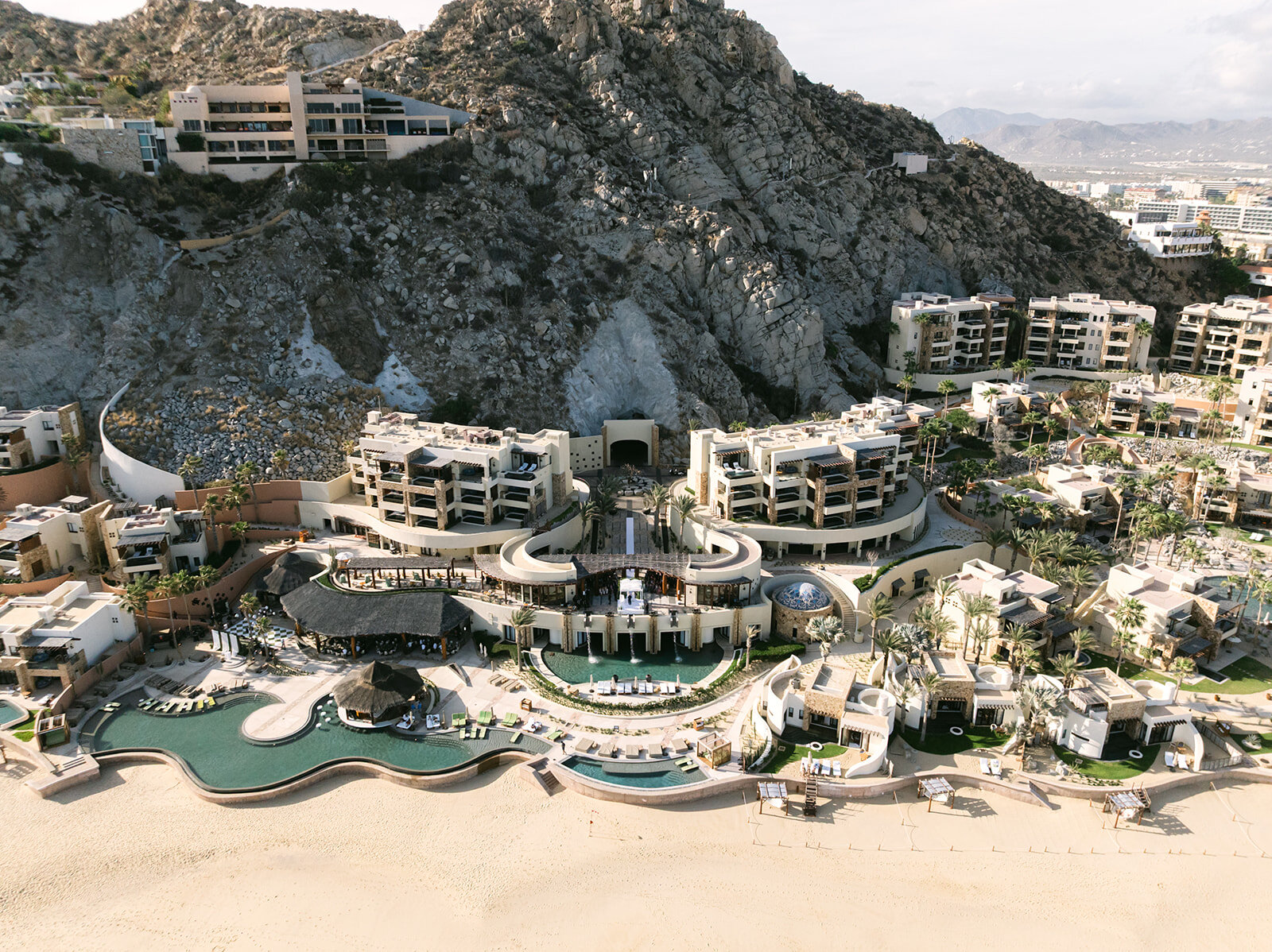
Where did the difference live? In the choices an average cannot see. One wedding took place at a landmark cliffside resort, with restrained, beautiful design and a tight roster of events. The other was built around a private-estate buyout for the welcome, a live band and a quartet on the wedding day, a far more ambitious floral and design scope, and a higher tier of venue throughout. Neither couple overspent. Each bought exactly the wedding they wanted. But a couple who walked into planning holding a single “average” would have been failed twice over: one of them frightened off by a number twice what they needed, the other left dangerously under-prepared for the wedding they had in mind.
That is what an average does. It is equally wrong for both of them.
What Actually Moves the Number
If the average is the wrong tool, what should you look at instead? In our experience, a destination wedding budget is moved, more than anything, by five real drivers.
Guest count is the multiplier beneath everything. It is not a line on the budget so much as the number every other line is quietly multiplied against, which is why curating it is the single most powerful financial decision you will make.
Venue, food, and beverage is almost always the largest figure, and it swings widely with the property you choose and the standard of its kitchen. Across our references it ran from the low $40,000s to over $130,000.
Design and production, the florals and rentals and lighting, the work that makes a space feel composed rather than rented, is the line couples most underestimate. When the design is ambitious, it can rival the venue itself.
Entertainment is a choice of register, from a string trio at the ceremony to a quartet, a mariachi, a live band, and DJs across several nights. It moves a budget far more than most couples expect.
And the weekend itself, the number and scale of the additional events, a bonfire welcome against a private-estate fiesta, a quiet farewell breakfast against a party boat at sea, can change a total by tens of thousands of dollars on its own.
Each of these lines carries its own range here, shaped by imported goods, a long peninsula supply chain, and a high season that runs roughly November through June. For those ranges set out line by line, from venue fees to catering to design and production, we keep a companion breakdown in Los Cabos Wedding Prices Explained.
Think Per Guest, and Price the Whole
So here is the better method, the one we use. Do not start with a lump sum, and never start with an average. Start with your real guest count and the experience you actually want, then price the full scope, not the visible slice. And think per guest, because per guest is the only figure that travels honestly across weddings of different sizes.
Across the three wedding weeks I have been describing, each spanning a welcome, a wedding day, and a send-off rather than a single evening, the all-in investment ran from roughly $1,800 to about $3,500 per guest. That is a real range, from real weddings on this coast, and it will serve you far better than any national average, because it is tethered to actual celebrations rather than a statistic. It also comes with an honest boundary. Even those figures, comprehensive as they are, do not include guest travel and hotels, attire, rings, stationery, or the personal things every couple buys on their own. A truly complete budget accounts for those too. The point is never to arrive at a smaller number. It is to arrive at a true one.
For the totals we actually see laid out by guest count and by venue category, our companion piece The Cost of a Los Cabos Destination Wedding walks through the full ranges, from an intimate wedding day to a multi-day celebration like the ones above.
A Last Word
This is the whole of it. A beautiful photograph will tell you what you want. Only an experienced planner can tell you what it costs, and a good one will walk you through every line with context before the numbers, so there are no surprises. At Karla Casillas & Co. we treat a couple’s budget as something to be understood, not guessed at, because the figure you plan around should be the figure you actually pay. The averages are a lovely place to dream. They are a terrible place to plan. Begin instead where the real work begins, with your guests, your priorities, and a true accounting of what the wedding you want will take. That number is entirely knowable. It is simply not in a magazine.
The House Journal is the editorial of Karla Casillas & Co.
With Care,
Karla Casillas



Be the first to comment